- contact@menspassportsociety.com

Blog
Our Latest Blogs & Articles
Join Lingo Society Today
Recent Blog
Ready to explore the South America?
Colombia Hub
Are you a Lingo Society member?

What Argentina Feels Like Culture & Energy
- Lingo Society
- Adventures
- Argentina
This is not a travel guide. It’s preparation.
Most people arrive in Argentina and spend the first few days adjusting — to the pace, the energy, the way people communicate, the social rules no one told them about.Some never fully do.The difference isn’t experience. It’s preparation. That’s what Lingo Society is built for. → Join the free community at lingosociety.com
No one fully prepares you for Argentina.Not the guidebooks. Not the Instagram reels. Not even the people who’ve been there before. You can read about the tango, the steak, the wide cobblestone boulevards. You can study the Spanish. You can map out every barrio in Buenos Aires before you land.
And still — the moment you step outside the airport, Argentina does something you didn’t expect. It pulls you in.
Not because it’s perfect. Argentina is complicated, loud, layered, and sometimes exhausting. But it has an energy that very few places in the world can match. And once you feel it, you understand why people come back. Most travelers experience Argentina on the surface and call it unforgettable. A smaller group goes deeper — and those are the people who actually understand what they were inside of. This blog is for the second group.
What Most Travelers Completely Misunderstand About Argentina
Most travelers land in Argentina expecting Latin America — and realize within 24 hours they don’t understand where they are.
That disorientation has a specific cause. Here’s what’s behind it:
- They expect a relaxed, familiar vibe. Argentina has a cultural identity unlike anywhere else on the continent — shaped by European immigration, political trauma, and a psychology that takes time to read.
- They interpret directness as conflict. Argentine communication is sharp and opinionated. That’s not aggression. That’s how respect works here.
- They think language is the barrier. It isn’t. The cultural layer — the unspoken rules, the social energy, the way people actually connect — is what determines your experience.
- They arrive without context and spend the whole trip feeling slightly off.
That ‘slightly off’ feeling is what preparation eliminates.
Why most people never fully experience Argentina
It’s not language.
It’s not money.
It’s not time.
It’s lack of cultural awareness.
That’s what separates tourists from people who actually connect.
And that gap is exactly what Lingo Society closes.

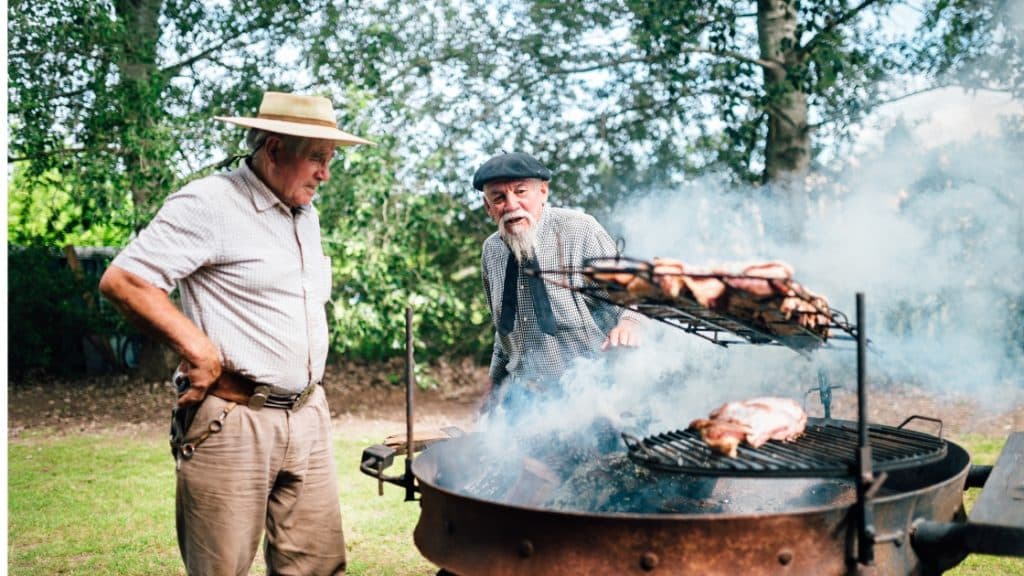
The Energy Is Electric — But Unhurried
Argentina moves at its own pace. This isn’t laziness. It’s philosophy.
Argentines live with an intensity that startles most travelers. Conversations are passionate. Opinions are strong. People talk with their whole body.
But nothing — absolutely nothing — is rushed.
Lunch starts at 1pm and ends when it ends. Dinner rarely begins before 9. A coffee with a friend is never fifteen minutes. A goodbye takes as long as it needs to. If you come from a culture that equates speed with productivity, this will feel disorienting — until it doesn’t.
UNPREPARED →
✗ You feel rushed and try to move things along
✗ You interpret the pace as disorganization
✗ You miss real connections because you’re watching the clock
PREPARED →
✓ You slow down and match the rhythm
✓ You understand that pace IS the culture
✓ You leave with relationships, not just memories
Are you a Lingo Society member?
Buenos Aires Is a City That Breathes
It’s been called the Paris of South America. That comparison is lazy. Buenos Aires is nothing like Paris. It’s bigger, warmer, louder, messier, and infinitely more alive.
Each neighborhood has its own personality:
- Palermo: creative, green, café culture on every corner
- San Telmo: old-world, tango at night, flea markets on weekends
- Recoleta: grand architecture, elegant streets, old money energy
- La Boca: color, football, murals, beautiful chaos
- Villa Crespo: locals, street food, underground music
You don’t experience Buenos Aires from a tour bus. You experience it by sitting in a café for three hours, getting lost and finding a bookshop you didn’t know existed, eating medialunas at midnight because you can. The city rewards presence.
Real situation: You’re alone at a café in Palermo. Someone at the next table starts talking to you.
This is normal. This is welcome. This is Argentina.
Don’t be startled. Don’t retreat.
A five-minute exchange can become a two-hour conversation — one of your best memories.
Most tourists miss this because they have their headphones in.
If this happens → Make eye contact. Stay open. Ask one follow-up question.
That’s all it takes.
Argentines Are Warm — And Relentlessly Opinionated
One of the first things travelers notice is how direct Argentines are. They will tell you exactly what they think. About politics. About food. About you, sometimes.
This isn’t rudeness. It’s respect.
In Argentine culture, directness is a form of honesty. Sugarcoating is not a social skill here — clarity is. A conversation without substance isn’t really a conversation. Combined with that: they are deeply affectionate. Greetings involve a kiss on the cheek. Warmth is physical. Space between people is smaller than you’re used to.
This combination — direct and warm — can feel overwhelming if you don’t understand the culture. If you do, it feels like being genuinely seen.
UNPREPARED →
✗ You interpret passion as anger and pull back
✗ You avoid close physical greetings and accidentally signal coldness
✗ You stay ‘polite’ and never engage — Argentines read this as indifference
PREPARED →
✓ You meet directness with directness and build instant credibility
✓ You accept the warmth and it opens everything
✓ You engage with real opinions — and they respect you for it
Key language note:
Argentines use ‘vos’ instead of ‘tú’ — this changes verb conjugations completely.
‘Che’ is the most Argentine word in existence. It means ‘hey’ but carries a whole world of texture.
If you use these naturally, even once, the warmth you receive will noticeably shift.
We teach this exact layer inside Lingo Society’s Travel Spanish track.
The Food Is More Than Steak
Yes, the steak is extraordinary. Yes, you should go to a parrilla at least once. But Argentine food culture is about so much more than meat.
It’s the medialunas from the corner bakery at 7am. The empanadas that vary by region — each one telling you where you are. The mate shared between strangers on a park bench. An entire social ritual in a single gourd.
Mate tells you everything you need to know about Argentine culture.
It’s bitter. It takes time to prepare. It is always shared — you never drink mate alone if there’s someone nearby. And if someone offers you their mate, you accept. Refusing it — even politely — reads as distance. Accepting it reads as belonging. That one gesture changes the dynamic of an entire interaction.
If someone offers you mate:
Accept it — even if you’ve never had it
Don’t stir the bombilla (the straw) — it’s considered rude
Drink the whole cup before passing back
Say ‘gracias’ only when you’re done for good — not between rounds
This is a full etiquette system. Most travelers never know it exists.
We cover it inside Lingo Society’s Culture section.
Tango Isn’t a Show. It’s a Conversation.
Tourists see tango as a performance. Argentines live it as a language.
The real tango — the milonga, the social dance — happens in dimly lit rooms where strangers become partners for three minutes and communicate without words. It’s not dramatic. It’s intimate.
Tango is about listening. About following. About two people negotiating movement without a word spoken. There is something deeply Argentine about that — the belief that the most important things happen in the space between words, and that presence is the highest form of communication.
You don’t need to dance to feel this. Watching a real milonga for thirty minutes will shift something in you.
Traveling Argentina as a Woman
Argentina is one of the most progressive countries in Latin America. Same-sex marriage has been legal since 2010. The feminist movement here — Ni Una Menos — sparked a wave across the continent. Argentine women are vocal, visible, and powerful.
That said, machismo still exists in pockets outside major cities. Street attention happens. It is cultural, not personal. And Buenos Aires is incredibly navigable as a solo woman — especially in the central barrios.
How to move through it confidently:
- Hold your energy — don’t contract or apologize for taking up space
- Eye contact is power here — use it deliberately and with calm
- Know the difference between attention and aggression — most of what you encounter is the former
- Move with intention in unfamiliar areas — not with fear, but with clarity
The key is confidence — not the performance of it, but the real kind. The kind that comes from understanding where you are.
Travel confidence is a skill we teach directly inside Lingo Society — especially for women navigating Latin America alone. → lingosociety.com
What the Language Actually Feels Like Here
Argentine Spanish sounds different from every other Spanish you’ve heard. Italian immigration waves of the 19th and 20th centuries shaped everything — the lilt of the language, the hand gestures, the rhythm of conversation.
The accent uses sh and zh sounds where other dialects use y and ll. Calle becomes CA-she. Yo becomes Sho. The slang is distinct. The conjugations are different.
Don’t be thrown off. Lean in.
Argentines notice when you try — and they respond with warmth that surprises most travelers. Knowing even a few phrases in Argentine Spanish (not just textbook Spanish) opens doors that nothing else can.
What most Spanish learners don’t know:
Standard Spanish courses teach ‘tú.’ Argentines use ‘vos.’ You’re flagged as a foreigner the moment you conjugate wrong.
Rioplatense Spanish has its own pronunciation, slang, and cadence.
Learning this isn’t advanced — it’s practical. And it changes how you’re received.
We teach the exact version of Spanish that Argentina speaks inside Lingo Society.
UNPREPARED →
✗ You use textbook Spanish and people politely correct you
✗ You feel like an outsider even when you’re understood
✗ You miss half of what’s being said because you only know standard Spanish
PREPARED →
✓ You use vos and local slang — people light up immediately
✓ You understand the humor, the warmth, the subtext
✓ You sound like someone who belongs here
Argentina Doesn’t Just Visit You. It Stays.
The travelers who come expecting a South American destination leave a little different than they arrived.
Something about the pace resets you. Something about the directness clarifies you. Something about the beauty — the wide boulevards, the river at sunset, the mountains you can feel before you see — stays in you long after you’re home.
You’ll remember the conversation at a stranger’s table that lasted until 2 am. The empanada that was the best thing you’d ever eaten, from a place with no sign. The moment you realized you were navigating Buenos Aires without a map — and it felt completely natural.
That’s what Argentina feels like.
Like becoming someone who knows how to arrive.
The Lingo Society Free Intelligent Tools